By Ken Howard, FaithX Founder and President
The FaithX blog now features a regular rotation of articles on four themes:
- Population Segments: Every month, we take a closer look at one or more of the 60 different populations described in our Missional Context Reports.
- Questions Nobody Is Asking: Each month, we pose a question that every congregation and judicatory should be asking, but many may be avoiding.
- Client Success Stories: Another monthly feature is a missional story about one of our many judicatory and congregational clients (maybe you have one to share).
- Guest Bloggers: Taking our own advice to listen to voices beyond our own, we feature a guest blogger every month (Interested? This could be you.)
Today, I will be looking at two very different population segments in the neighborhoods surrounding a congregation I know (one I actually attend), exploring how they compare to the populations that make up the congregation, and the missional implications of the similarities and differences.
As we often do with our congregational clients, we ran two Neighborhood Insights Reports, for two different drive-times around the congregation.
- 15-minute drive-time – The Membership Area. We call this the Membership Area. Research shows that roughly 70% of a congregation’s attendees will come from this area.
- 5-minute drive-time – The Ministry Area. We call this the Ministry Area because it includes the neighborhood which the congregation’s ministry can have the greatest impact.
What did these reports reveal about the populations that make up these areas?
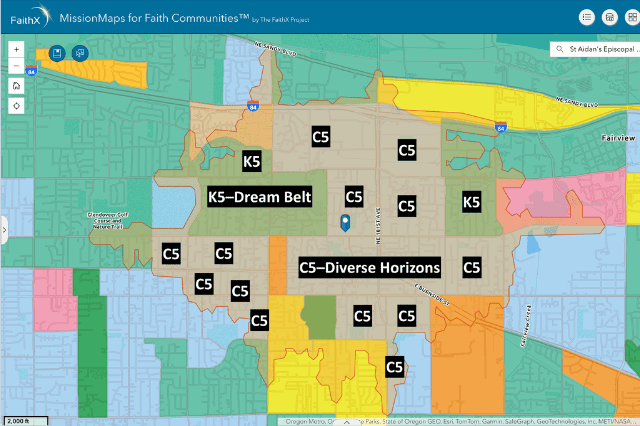
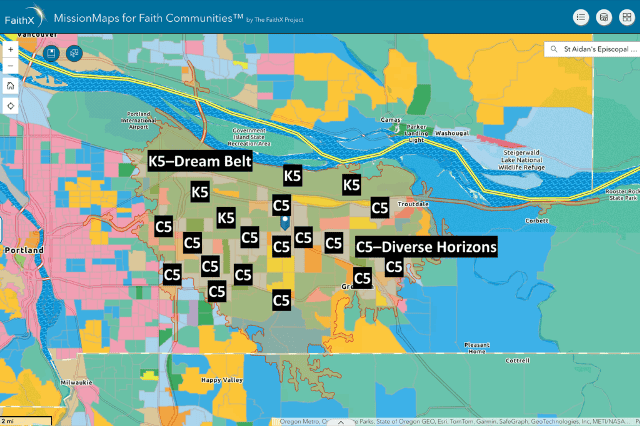
We found the same two very different population segments were predominant in both areas: one is called Diverse Horizons, and the other is called Dreambelt.
- Diverse Horizons: Very diverse (nearly 1/2 Hispanic), rent-burdened, liberal-leaning, 40-something immigrant families, singles, & singles with relatives; white-collar; low-income; tech-savvy, with potential housing, hunger, and legal/immigration issues.
The Diverse Horizons segment comprises 31% of the Membership Area and 61% of the Ministry Area.
- Dreambelt: Somewhat diverse (1-in-5 Hispanic), rent-burdened, middle-aged, and mostly retired; tech-friendly, white-collar; high-income; with potential senior isolation & assisted living issues.
The Dreambelt segment comprises 23% of the Membership Area and 19% of the Ministry Area.
Click here for a Population Segment Map of the 5-min drive-time Ministry Area
Click here for a Population Segment Map of the 15-min drive-time Membership Area
How does this compare to the congregation?
The congregation consists of the same two segments, but the percentages are significantly different from those of the surrounding population. Our best estimates of the congregations’ makeup are:
- Dreambelt: 80% of the congregation is white, middle-aged, retired, theopolitically liberal-leaning
- Diverse Horizons: 10% of the congregation’s membership is young and Hispanic.
What are the missional implications for the congregation? The differences in proportions of the two segments represent both a significant opportunity and a significant challenge.
- A massive opportunity for missional evangelism: There is great, untapped potential for growth in membership and ministry if the congregation can find a way to engage the Diverse Horizons population, which is currently greatly underrepresented.
- A massive challenge for missional evangelism: It is always easier to reach people who are similar to you, but much harder to reach people who are different.
The congregation is currently considering how to lean into the opportunity while overcoming the challenges.
One thing is clear: They are recognizing that they will need to listen carefully to the minority of the congregation who are of the Diverse Horizons group about what they see as the hopes, dreams, and needs of the people who make up the largest population of their Membership area and the overwhelming majority of the Ministry Area.